
SPF 60 Protection Without the White Cast
In Pakistan, sun protection is not just a summer skincare step—it is an essential part of daily skin health. Strong sunlight, outdoor exposure, heat, and high UV levels can contribute to sunburn, tanning, premature skin aging, and uneven pigmentation. For people already investing in serums, moisturizers, and pigmentation treatments, sunscreen is often the step that protects those efforts.
But finding the best sunblock for your skin is not always straightforward. Dry skin may need hydration, oily skin often prefers a lightweight texture, and sensitive skin may tolerate certain UV filters better than others. Many people also avoid sunscreen because they dislike greasiness or a visible white cast.
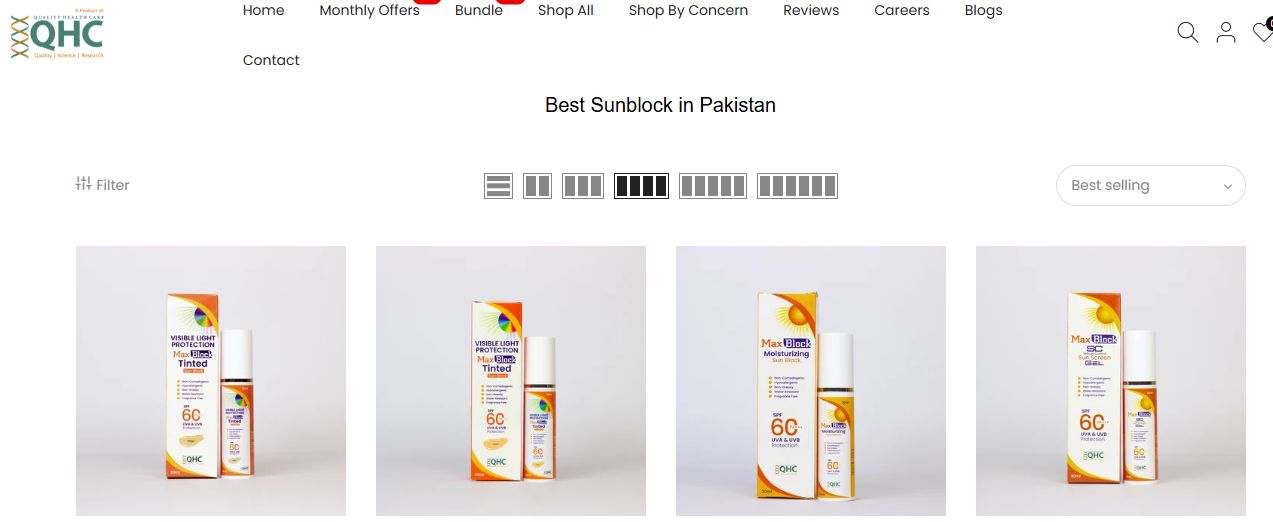
The good news is that modern formulations offer options for different skin types and lifestyles. QHC Max Block SPF 60, developed by American Board-Certified Dermatologists, is available in moisturizing, gel, and tinted formulations designed around different skincare needs.
Why Sunblock Is Non-Negotiable in Pakistan
Sunlight contains ultraviolet radiation, particularly UVA and UVB rays, that can affect the skin even when you do not immediately notice a sunburn.
UVB is strongly associated with sunburn, while UVA penetrates more deeply into the skin and contributes to photoaging and pigmentation. Both types of UV radiation can damage skin cells.
Pakistan experiences substantial sunlight throughout much of the year, making consistent sun protection particularly important for people who spend time outdoors. Depending on location, season, weather, and time of day, the UV Index can reach very high or extreme levels.
This is why sunscreen should not be treated as an occasional product for beach holidays. It belongs in a normal morning skincare routine.
Sunscreen Protects More Than Your Skin
Many people use vitamin C, niacinamide, retinoids, exfoliating products, and pigmentation treatments to improve their complexion. However, ongoing UV exposure can contribute to pigmentation and premature skin aging.
Daily sunscreen therefore works as a protective foundation for the rest of your skincare routine.
It does not mean that sunscreen will automatically make every skincare product work better. Rather, it helps reduce one of the environmental factors that can continue to damage or darken the skin while you are trying to improve its appearance.
How to Choose the Best Sunblock for Your Skin Type
There is no single sunscreen texture that is perfect for everyone. Your skin type, climate, daily activities, and personal preference should all influence your choice.
Let’s look at the most practical options.
Best Sunblock for Dry Skin in Pakistan
Dry skin usually benefits from a sunscreen that provides protection without leaving the skin feeling tight or uncomfortable.
Look for formulations containing moisturizing or conditioning ingredients such as:
- Jojoba oil
- Almond oil
- Glycerin
- Cucumber extract
- Other skin-supporting emollients
QHC Max Block SPF 60 Moisturizing Sunblock
QHC Max Block SPF 60 Moisturizing Sunblock is designed for people who want sun protection combined with a more moisturizing texture. Its formulation includes Zinc Oxide, Almond Oil, Jojoba Oil, and Cucumber Extract.
For someone searching for the best sunblock for dry skin in Pakistan, a moisturizing formulation can be particularly useful during dry weather or winter, when the skin may lose moisture more easily.
However, very dry skin may still benefit from applying a dedicated moisturizer underneath sunscreen if needed.
Moisturizing Sunblock for Sensitive Skin
Sensitive skin requires extra care because some sunscreen or skincare ingredients can cause irritation in susceptible individuals.
For sensitive skin, consider:
- Gentle formulations
- Mineral UV filters such as zinc oxide
- Fragrance-free options when fragrance is a known trigger
- Hydrating ingredients
- Products that do not sting or cause persistent redness
Why Zinc Oxide Is Popular for Sensitive Skin
Zinc oxide is a mineral UV filter used in sunscreens. It provides broad-spectrum protection and is commonly recommended as an option for people with sensitive skin.
However, “mineral” does not automatically mean that a product will suit everyone. Individual reactions are possible, so patch testing a new product can be sensible if your skin is reactive.
A moisturizing sunblock for sensitive skin should leave your skin protected and comfortable rather than tight, burning, or excessively greasy.
Best Sunblock for Oily and Acne-Prone Skin
Oily skin does not mean you should skip sunscreen.
In fact, finding a comfortable sunscreen is one of the best ways to make daily sun protection easier to maintain.
If you have oily or acne-prone skin, consider:
- Lightweight textures
- Gel-based formulations
- Oil-free options
- Fast-absorbing formulas
- Non-comedogenic products where available
QHC Max-Block SPF 60 Sunscreen Gel
QHC Max-Block SPF 60 Sunscreen Gel is an oil-free, lightweight option designed to absorb quickly.
A gel sunscreen can be particularly appealing in Pakistan’s hot and humid weather because it may feel lighter than a richer cream formulation.
Remember, though, that sunscreen texture is highly personal. If a gel causes dryness or irritation, switching to a more moisturizing formulation may be more appropriate.
Tinted Sunscreen Pakistan: An Option for Everyday Wear
One of the most common complaints about sunscreen—particularly mineral sunscreen—is the white cast it can sometimes leave on the skin.
A tinted sunscreen can be an attractive alternative because the tint can help reduce the visible appearance of sunscreen residue while providing a more even-looking complexion.
QHC Max Block SPF 60 Tinted Sunblock
QHC Max Block SPF 60 Tinted Sunblock contains Titanium Dioxide, Zinc Oxide, Almond Oil, and Jojoba Oil.
For people searching for tinted sunscreen Pakistan, a tinted formulation can be especially convenient when you want sun protection with a little complexion-enhancing coverage.
Tinted sunscreens containing iron oxides may also offer an additional advantage against visible light, which can be relevant for people concerned about hyperpigmentation, particularly those prone to melasma.
Why SPF 60 Matters
SPF, or Sun Protection Factor, primarily describes protection against UVB radiation.
An SPF 60 sunblock offers very high UVB protection when applied correctly. It is important, however, not to interpret SPF as a percentage of total sunlight being blocked.
For example, SPF 30 filters approximately 97% of UVB, while SPF 50 filters approximately 98%. SPF 60 provides slightly higher theoretical protection, but the difference is relatively small compared with SPF 30 or 50.
The bigger issue is how much sunscreen you apply and whether you reapply it.
Broad-Spectrum Protection Is Essential
SPF alone does not tell you the complete story.
A sunscreen should ideally provide broad-spectrum protection, meaning protection against both UVA and UVB radiation.
Why does this matter?
- UVB: Primarily responsible for sunburn and contributes to skin cancer.
- UVA: Penetrates more deeply and contributes to photoaging and pigmentation.
If your primary concern is pigmentation, broad-spectrum protection is especially important.
What About PA+++?
PA ratings are used in some markets to indicate UVA protection. Generally, more plus signs indicate stronger UVA protection.
However, consumers should not rely on the PA system alone. Look for clearly stated broad-spectrum protection and follow the product’s labeled directions.
Key Ingredients to Look for in a Sunblock
Understanding sunscreen ingredients can make choosing a product much easier.
Zinc Oxide
Zinc oxide is a mineral UV filter that provides broad-spectrum protection. It is often used in sunscreen formulations intended for sensitive skin.
Modern formulations can combine zinc oxide with other ingredients to improve texture and cosmetic elegance.
Titanium Dioxide
Titanium dioxide is another mineral UV filter. It is particularly effective against UVB and some UVA wavelengths.
It is frequently found in mineral and tinted sunscreen formulations.
Almond Oil
Almond oil is an emollient ingredient used in skincare to help condition and soften the skin.
In a sunscreen, it can contribute to a more moisturizing skin feel, making it useful in formulations intended for dry skin.
Jojoba Oil
Jojoba oil is commonly used as a conditioning ingredient because of its similarity to some components of the skin’s surface lipids.
It can help improve the feel of moisturizing skincare products without necessarily creating the heavy sensation associated with some richer oils.
Glycerin
Glycerin is a well-established humectant. Humectants help attract and retain water in the outer layers of the skin.
It is commonly found in moisturizers and sunscreen formulations designed to support comfortable hydration.
Cucumber Extract
Cucumber extract is commonly used in skincare products for its soothing and refreshing qualities.
When combined with moisturizing ingredients, it can contribute to a comfortable daytime skincare experience.
How to Use Sunblock Correctly
Even the best SPF 60 sunblock cannot provide its labeled protection if you use too little.
Follow these steps for better protection.
Complete Your Morning Skincare
Apply your cleanser, serum, and moisturizer first.
Sunscreen should generally be the final skincare step before makeup.
Apply Enough
A tiny pea-sized amount is usually not enough for adequate sunscreen coverage on the face and exposed areas.
A commonly used practical method is the two-finger method for the face and neck, although the exact amount depends on the product and area being covered.
The goal is generous, even coverage.
Apply Before Going Outdoors
Apply sunscreen before sun exposure so it has time to form an even protective layer on the skin. Many sunscreen instructions recommend applying around 15 minutes before going outside.
Don’t Forget Commonly Missed Areas
Pay attention to:
- Ears
- Neck
- Hairline
- Forehead
- Around the nose
- Back of the hands
If your lips are exposed, use a lip product with appropriate sun protection.
Reapply
Reapplication is essential when you are outdoors for extended periods.
Reapply approximately every two hours, and sooner after swimming, sweating, or towel drying if the product’s directions call for it.
Common Sunblock Mistakes to Avoid
Skipping Sunscreen on Cloudy Days
Clouds do not eliminate UV exposure. Even when the sky looks grey, UV radiation can still reach your skin.
Make sunscreen part of your daily routine rather than deciding whether to use it based only on how sunny the weather appears.
Relying on Makeup SPF
Foundation or BB cream with SPF can provide some protection, but most people do not apply enough makeup to achieve the labeled SPF.
Treat makeup with SPF as an additional layer rather than your primary sunscreen.
Applying Too Little
This is one of the biggest problems with sunscreen use. Applying a thin layer may leave significant areas inadequately protected.
Forgetting to Reapply
Morning application is not always enough if you spend several hours outside.
Sweat, rubbing, washing, and time can reduce protection, making reapplication important.
Choosing Texture Over Protection
A sunscreen that feels beautiful but is applied too sparingly won’t provide adequate protection.
Choose a product that combines appropriate protection with a texture you can comfortably apply in sufficient quantity.
How to Avoid a White Cast Without Sacrificing Protection
If you dislike the white cast associated with some sunscreens, you don’t have to abandon mineral protection.
Consider:
1. Try a tinted formulation.
Tint can help make the finish look more natural.
2. Choose a formulation designed for your skin tone.
A sunscreen that blends well is much easier to wear consistently.
3. Apply evenly.
Instead of placing one thick blob on the face, distribute the sunscreen across several areas and blend gently.
4. Don’t intentionally under-apply.
Reducing the amount just to avoid a white cast compromises protection.
Consistency matters more than chasing a perfectly invisible finish.
Choosing a Winter Sunblock in Pakistan
Sunscreen isn’t only for hot summer months.
UV exposure occurs throughout the year, so your winter skincare routine should also include sun protection.
During colder or drier months, you may prefer a creamier sunscreen with moisturizing ingredients such as jojoba oil, almond oil, glycerin, or other emollients.
If your skin becomes oily during warmer months, you might prefer switching to a lightweight gel formulation.
The ideal approach is not necessarily to use one sunscreen forever. Your skin’s needs can change with weather, activity, and lifestyle.
Final Thoughts: Make Sun Protection Your Daily Habit
Choosing the best sunblock for dry skin in Pakistan, oily skin, sensitive skin, or combination skin starts with understanding what your skin actually needs.
Dry skin may benefit from a moisturizing sunscreen containing conditioning ingredients. Oily and acne-prone skin may prefer a lightweight, non-greasy gel. If you’re concerned about white cast or want light complexion coverage, a tinted sunscreen in Pakistan can be a practical option.
Whatever formulation you choose, prioritize broad-spectrum protection, adequate application, and regular reapplication.
Sunblock isn’t simply another skincare product sitting on your shelf. It is the protective foundation of your daytime routine. When you find an SPF 60 sunblock that feels comfortable enough to use every day, you’re far more likely to make sun protection a lasting habit.